
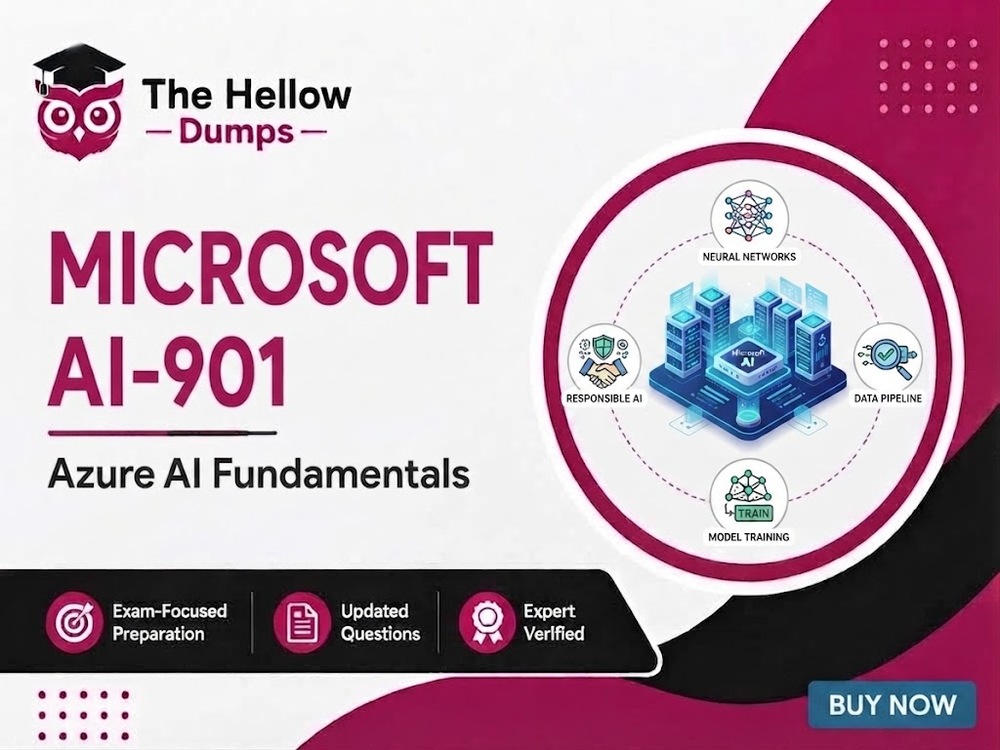
Artificial intelligence is becoming an important part of modern cloud technology, and Microsoft has introduced AI-focused certifications for professionals who want to build practical skills. AI-901 Microsoft Exam Info is especially useful for beginners who want to understand the current Microsoft Azure AI Fundamentals certification, its objectives, preparation requirements, and available practice resources. The exam focuses on foundational AI concepts as well as implementing AI solutions with Microsoft Foundry.
What Is the Microsoft AI-901 Exam?
Microsoft AI-901 is the exam associated with the Microsoft Certified: Azure AI Fundamentals certification. It is designed for candidates who are beginning their careers in AI solution development. Microsoft recommends having conceptual knowledge of AI solutions in Azure, familiarity with Azure resources, and basic knowledge of Python syntax and programming techniques.
For anyone researching AI-901 Microsoft Exam Info, it is important to understand that this is a fundamentals-level certification. You do not need to be an experienced AI engineer to begin preparing, but you should understand basic cloud and artificial intelligence concepts.
The exam was updated in English on April 15, 2026, so candidates should always use the latest Microsoft study guide rather than relying on older preparation material.
Main Skills Covered in AI-901
The current AI-901 objectives are divided into two major areas. The first is identifying AI concepts and capabilities, which represents approximately 40–45% of the exam. The second is implementing AI solutions using Microsoft Foundry, representing approximately 55–60%.
When reviewing AI-901 Microsoft Exam Info, these percentages can help you prioritize your preparation time.
The first section includes topics such as responsible AI, generative AI models, AI workloads, text analysis, speech capabilities, computer vision, and information extraction.
The second section focuses more on implementation. Candidates should understand how to work with generative AI applications and agents, text and speech solutions, computer vision, image generation, and information extraction through Microsoft Foundry.
Responsible AI Concepts
Responsible AI is an important part of the updated AI-901 objectives. Candidates should understand concepts such as fairness, reliability, safety, privacy, security, inclusiveness, transparency, and accountability.
Rather than memorizing isolated definitions, try to understand how these principles apply to real-world AI systems. For example, fairness concerns whether an AI solution produces inappropriate differences between groups, while transparency relates to understanding and communicating how an AI system operates.
This approach makes AI-901 Microsoft Exam Info more useful as a preparation reference because it connects individual objectives with practical scenarios.
Generative AI and AI Models
Generative AI is another major area in the current exam objectives. Candidates should understand how generative AI models work and how to select appropriate models based on their capabilities.
You should also become familiar with deployment options and configuration parameters. Prompting is relevant as well, because the current objectives include creating effective system and user prompts for generative AI models.
A good preparation strategy is to experiment with simple prompts and observe how changing instructions affects the generated output. Practical experimentation can make abstract concepts easier to remember.
Microsoft Foundry and AI Implementation
Microsoft Foundry has a significant role in the current AI-901 exam. The objectives include deploying models, interacting with them through the Foundry portal, creating lightweight applications using the Foundry SDK, and working with single-agent solutions.
Candidates researching AI-901 Microsoft Exam Info should therefore spend time understanding the Microsoft Foundry environment instead of concentrating only on theoretical AI definitions.
The implementation objectives also cover text analysis, speech, computer vision, image generation, and information extraction. Hands-on learning can help you understand how these capabilities fit together.
Computer Vision, Speech, and Information Extraction
AI-901 also tests foundational knowledge of several common AI workloads. These include speech recognition and synthesis, computer vision, image-generation capabilities, and techniques for extracting information from text, images, audio, and video.
For example, you should understand common text-analysis techniques such as keyword extraction, entity detection, sentiment analysis, and summarization. You should also know how AI systems can process visual and audio information.
Reviewing AI-901 Microsoft Exam Info alongside practical Microsoft Learn modules can make these topics easier to organize.
How to Prepare for AI-901
A structured study plan is usually more effective than trying to memorize a large collection of questions. Start with the official AI-901 study guide and identify each objective. Then use Microsoft Learn resources to study the concepts behind those objectives.
Microsoft recommends training and hands-on experience before taking the exam. Its official resources include self-paced learning options, instructor-led training, documentation, community resources, and videos.
When studying AI-901 Microsoft Exam Info, divide your preparation into manageable sections:
- Learn fundamental AI concepts.
- Study responsible AI principles.
- Understand generative AI and model selection.
- Explore Microsoft Foundry.
- Review text and speech solutions.
- Study computer vision and image generation.
- Learn information extraction concepts.
- Complete practice questions and review weak areas.
Free Practice Test and Practice Assessment
Practice testing can help identify knowledge gaps before the actual certification exam. Microsoft currently lists AI-901 among the certifications supported by its Practice Assessments. These assessments are available at no cost, can be attempted multiple times, and provide score reports with answers, rationales, and links to additional learning resources.
This makes the official practice assessment particularly valuable for candidates looking for AI-901 Microsoft Exam Info and preparation resources without depending on unauthorized exam dumps.
Remember that practice questions should be used to measure your understanding rather than memorize answers. If you get a question wrong, study the underlying concept and try a similar scenario again.
Exam Preparation Tips
One useful approach is to combine theoretical study with practical exercises. Reading about generative AI is helpful, but actually experimenting with prompts can provide a stronger understanding.
Create short revision notes for important concepts and review them regularly. Pay particular attention to areas where you repeatedly make mistakes.
Also, keep your preparation aligned with the latest Microsoft objectives. Because certification exams can be updated, older articles and outdated question banks may not accurately represent the current exam.
For candidates comparing different sources of AI-901 Microsoft Exam Info, Microsoft’s official exam page and study guide should be treated as the primary references.
Final Thoughts
AI-901 is a useful starting point for professionals who want to develop foundational knowledge of artificial intelligence on Azure. The current objectives place considerable emphasis on Microsoft Foundry, generative AI, responsible AI, and practical implementation concepts.
The best preparation method is to understand the skills measured by Microsoft, work through official learning resources, practice with hands-on examples, and use legitimate practice assessments to measure progress.
If you are collecting AI-901 Microsoft Exam Info before beginning your preparation, make sure your study material matches the 2026 objectives. A focused preparation plan can help you approach the certification with greater confidence while building skills that extend beyond the exam itself.
ORDER IT NOW: Microsoft AI-901 Exam Questions Answers



Leave a Reply